
RELATIVE DENSITY
Relative density says where a sand or gravel sits between its loosest and densest possible packing, using the void ratio, and it controls how strong, stiff and compressible the soil is.
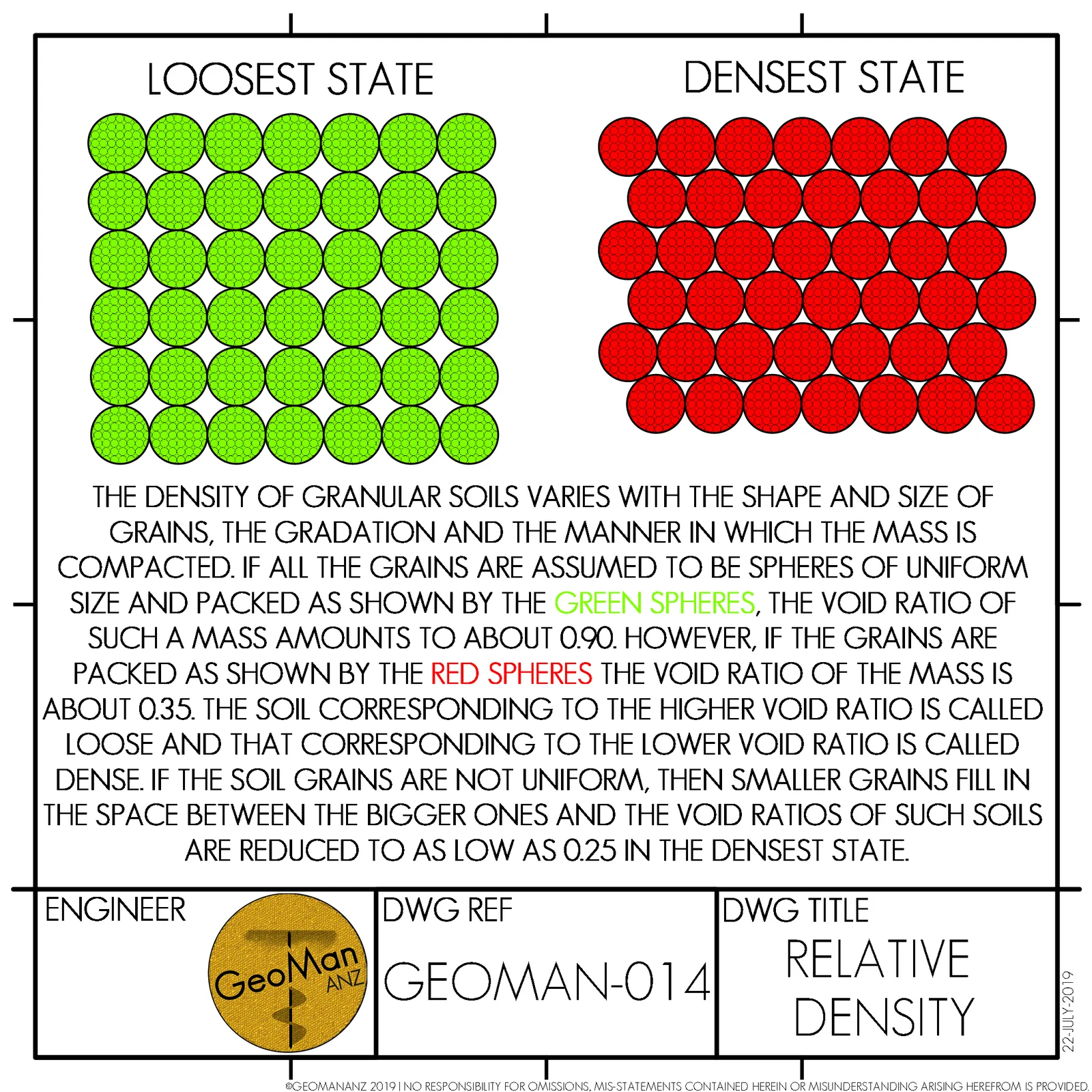
- Sheet
- GEOMAN-014
- Title
- RELATIVE DENSITY
- First posted
- 22 Jul 2019 (first appearance in the Instagram archive)
- Parts
- 1
What the sheet shows
The sheet draws uniform spheres at their loosest and densest packing. The loosest packing has a void ratio of about 0.90; the densest about 0.35. It notes that for grains of different sizes the void ratio can fall to about 0.25, because small grains fill the gaps between large ones.
How it works
Void ratio e is the volume of voids divided by the volume of solids. For identical spheres stacked directly on top of each other (cubic packing) the voids take up almost half the volume. Shift each layer into the hollows of the layer below and the spheres pack more closely. Real sand is neither uniform nor spherical, but it has the same two limits: a maximum void ratio, emax, when it is as loose as it can be, and a minimum void ratio, emin, when it is as dense as it can be.
Relative density, also called density index, places the actual void ratio between those limits [1]. It matters because dense sand interlocks: to shear it, grains must ride up over each other, so it dilates and is strong and stiff. Loose sand contracts when sheared and, if saturated and loaded quickly, can lose strength.
Key equation
Dr = (emax - e) / (emax - emin)
Worked example
A sand has emax = 0.85 and emin = 0.45. In the ground its void ratio is 0.60. Then Dr = (0.85 - 0.60) / (0.85 - 0.45) = 0.25 / 0.40 = 0.63, or 63 percent. That is commonly described as medium dense to dense, near the upper end of medium dense.
In practice
Relative density is rarely measured directly in the ground, because undisturbed samples of clean sand are hard to take. It is usually estimated from penetration tests (SPT blow counts or CPT cone resistance) through correlations, then used to choose a friction angle and stiffness. Check which correlation and which density terms your local standard uses.
REFERENCES
- [1] ASTM International (2024). ASTM D653-24: Standard Terminology Relating to Soil, Rock, and Contained Fluids. ASTM International.https://store.astm.org/d0653-24.html. Accessed 31 Oct 2026.