
PARTICLE SIZE DISTRIBUTION
A particle size distribution curve plots the percentage of a soil finer than each grain size on a log scale; its shape shows whether the soil is well graded, uniformly graded or gap graded.
- Sheet
- GEOMAN-053
- Title
- PARTICLE SIZE DISTRIBUTION
- First posted
- 24 Dec 2019 (first appearance in the Instagram archive)
- Parts
- 1
What the sheet shows
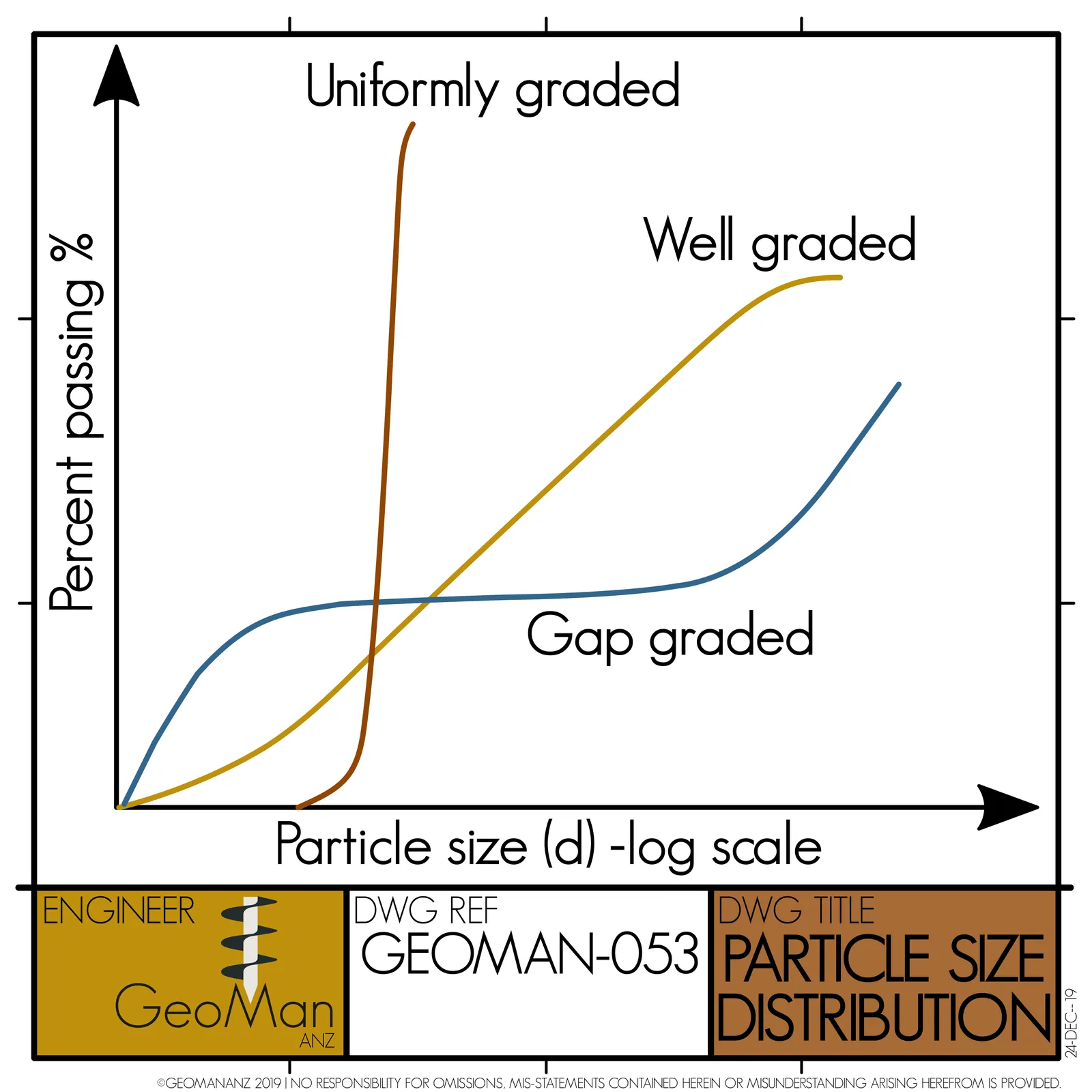
The sheet plots three particle size distribution (PSD) curves: percentage passing on the vertical axis against particle size on a logarithmic horizontal axis. One curve is uniformly graded, one well graded and one gap graded.
How it works
The coarse part of the curve comes from sieving: a dried sample is shaken through a stack of sieves, and the mass retained on each is weighed [1]. The fine part, silt and clay, comes from a sedimentation test. Each point on the curve is the percentage of the sample finer than that size.
The shape tells you how the grains pack. A uniformly graded soil has most grains about the same size, so the curve is steep and nearly vertical. A well graded soil has a wide spread of sizes, so the curve is a long smooth S; small grains fill the gaps between large ones, which gives high density and good strength. A gap graded soil is missing a range of sizes, and the curve has a flat step.
Key equation
Cu = D60 / D10, Cc = (D30)² / (D10 · D60)
Worked example
From a curve, D10 = 0.1 mm, D30 = 0.4 mm and D60 = 1.2 mm. Then Cu = 1.2 / 0.1 = 12 and Cc = 0.4² / (0.1 × 1.2) = 0.16 / 0.12 = 1.3. Under the Unified Soil Classification System a sand is well graded when Cu is at least 6 and Cc is between 1 and 3 [2], so this is a well graded sand if its fines content is low.
In practice
Grading drives decisions well beyond classification. It controls whether a fill compacts well, whether a filter will stop the soil next to it washing through, how permeable the ground is, and whether a sand is prone to liquefaction. Uniform fine sands and gap graded soils are the ones to watch: the first can liquefy, the second can lose its fines by internal erosion.
REFERENCES
- [1] ASTM International (2017). ASTM D6913/D6913M-17: Standard Test Methods for Particle-Size Distribution (Gradation) of Soils Using Sieve Analysis. ASTM International.https://store.astm.org/d6913_d6913m-17.html. Accessed 31 Oct 2026.
- [2] ASTM International (2017). ASTM D2487-17: Standard Practice for Classification of Soils for Engineering Purposes (Unified Soil Classification System). ASTM International.https://store.astm.org/d2487-17.html. Accessed 31 Oct 2026.