
DYNAMIC CONE PENETROMETER
The dynamic cone penetrometer is a hand-held test that drives a cone into the ground with a falling weight and records penetration per blow, giving a quick profile of soil strength in the top metre or so.
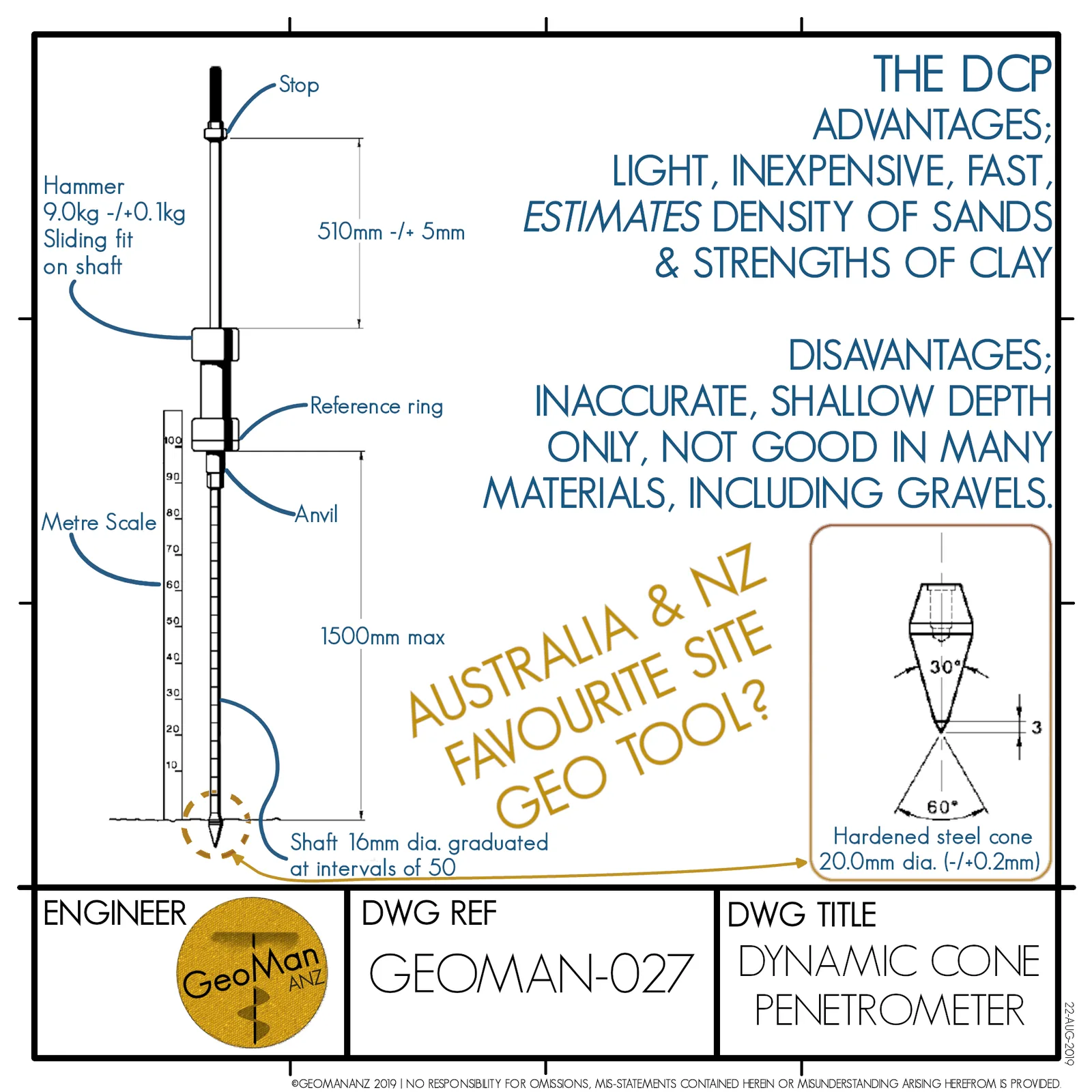
- Sheet
- GEOMAN-027
- Title
- DYNAMIC CONE PENETROMETER
- First posted
- 23 Aug 2019 (first appearance in the Instagram archive)
- Parts
- 1
What the sheet shows
The sheet draws the dynamic cone penetrometer (DCP) and labels it: a 9.0 kg hammer dropped 510 mm onto a 16 mm shaft with a 20 mm cone, to a maximum depth of about 1500 mm. It lists pros and cons of the test and calls it a favourite site tool in Australia and New Zealand.
How it works
The operator stands the rod upright, lifts the hammer to the top of its travel and lets it fall onto the anvil. Each blow drives the cone further. Penetration is read against a scale on the rod, and the result is recorded as blows per 100 mm of penetration, or as millimetres per blow. A soft layer shows as many millimetres per blow; a dense or stiff layer as few.
The DCP is used to check subgrade and pavement layers, to confirm that a footing base matches the design assumption, and to find soft spots between boreholes. Results are often converted to an estimated California Bearing Ratio (CBR) with an empirical correlation.
There is more than one version. The sheet shows the version common in Australia and New Zealand. ASTM D6951 describes a version with an 8 kg hammer and a 575 mm drop, and its own correlation to CBR for shallow pavement work [1]. Make sure any correlation used matches the apparatus.
In practice
The pros are speed, cost and access: one person can carry it and test where no rig can reach. The cons are depth, about the 1.5 m the sheet gives, and interpretation. Gravel and cobbles stop the cone and give false refusals. Very soft clays can show little resistance even when the cone is moving through them. Use the DCP to compare locations and confirm assumptions, not as the only basis for a design. Record the hammer, the cone and the zero reading on every log so results from different sites can be compared.
REFERENCES
- [1] ASTM International (2018). ASTM D6951/D6951M-18: Standard Test Method for Use of the Dynamic Cone Penetrometer in Shallow Pavement Applications. ASTM International.https://store.astm.org/d6951_d6951m-18.html. Accessed 31 Oct 2026.