
SKIN FRICTION
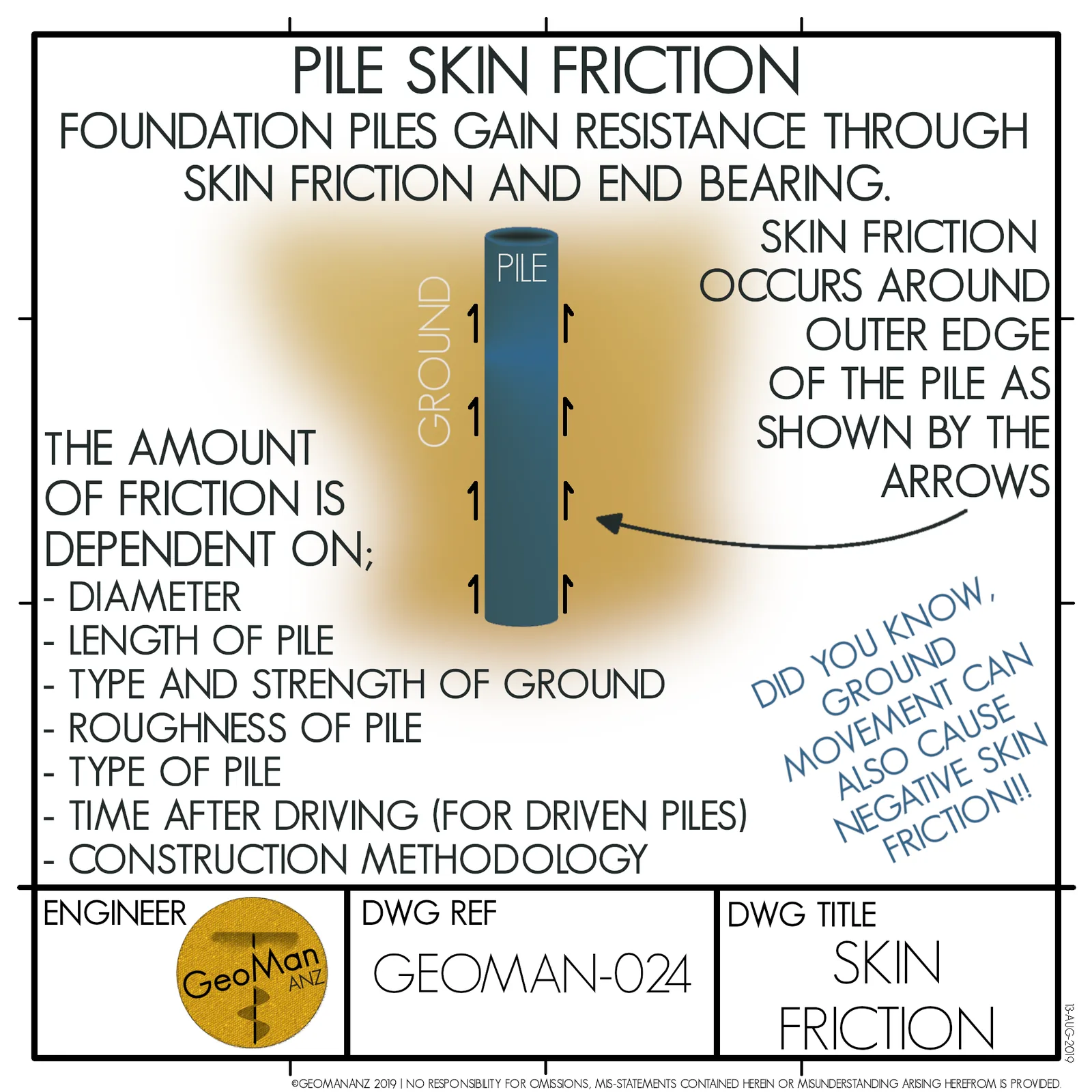
Skin friction is the resistance along the side of a pile as it is pushed into the ground; it depends on the ground, the pile type and how the pile was installed, and settling ground can reverse it into a downward drag called negative skin friction.
- Sheet
- GEOMAN-024
- Title
- SKIN FRICTION
- First posted
- 15 Aug 2019 (first appearance in the Instagram archive)
- Parts
- 1
- Topics
- Piling and foundations
What the sheet shows
The sheet lists what skin friction depends on: pile diameter and length, the ground, the roughness of the pile surface, the pile type, the time after driving and the construction method. It also shows negative skin friction, where the ground settles past the pile and drags it down.
How it works
A loaded pile moves down a few millimetres relative to the soil around it. Shear stress develops along the shaft, and summed over the shaft area it gives the shaft resistance. Only a small movement is needed to mobilise it, much less than for end bearing.
In clay the shaft resistance is usually linked to the undrained strength through an adhesion factor, alpha. In sand it is linked to the effective vertical stress through a factor beta, which bundles the horizontal stress and the interface friction angle [1]. Installation changes both. Driving displaces and densifies sand around the pile, while boring loosens it. In clay, driving disturbs the soil, and capacity recovers as excess pore pressure dissipates over days or weeks, which is why time after driving is on the list.
Negative skin friction happens when the soil around the upper part of a pile settles more than the pile does, for example under new fill on soft clay. The soil then hangs on the pile and adds load instead of resisting it.
Key equation
Qs = Σ fs · As, fs = α · cu (clay) or fs = β · σ'v (sand)
Worked example
A 0.6 m diameter bored pile passes 15 m through clay with cu = 50 kPa. Taking α = 0.5, fs = 25 kPa. The shaft area is π × 0.6 × 15 = 28.3 m², so Qs = 25 × 28.3 = 707 kN before factors. Values of α vary with the pile type and the method, so take them from the design method in use.
In practice
Load test where you can; a test pile calibrates every assumption in the calculation. Where fill is being placed on soft ground, include drag load from negative skin friction in the structural check and the settlement check.
REFERENCES
- [1] Federal Highway Administration (2016). Design and Construction of Driven Pile Foundations, Volume I (Geotechnical Engineering Circular No. 12), FHWA-NHI-16-009. U.S. Department of Transportation.https://www.fhwa.dot.gov/engineering/geotech/pubs/gec12/nhi16009_v1.pdf. Accessed 31 Oct 2026.