
TRANSCONA GRAIN SILO COLLAPSE
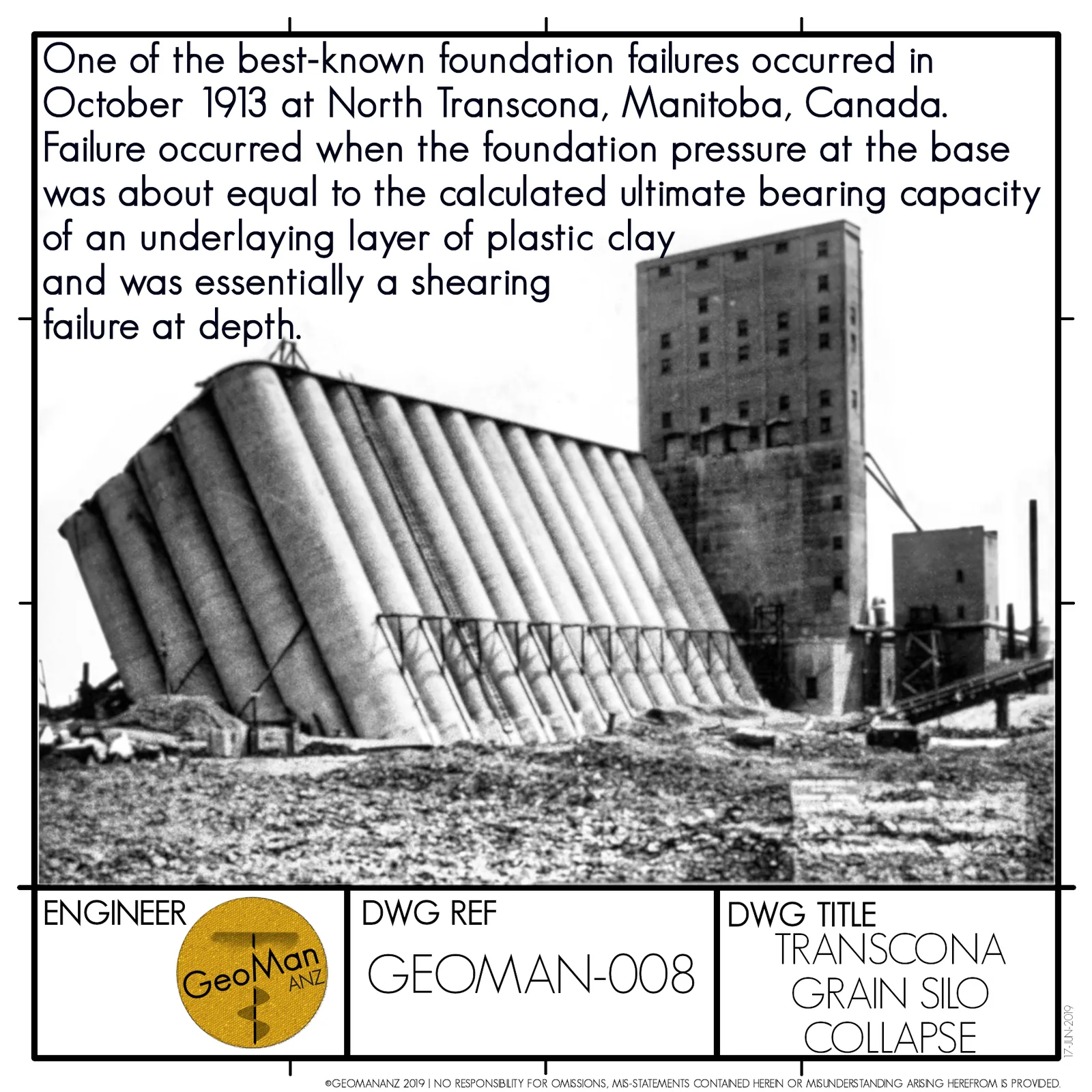
In 1913 the Transcona grain elevator in Winnipeg, Canada, tilted while it was being loaded with grain because the bearing pressure exceeded the shear strength of the clay below; later analysis showed the failure pressure was close to the value predicted by bearing capacity theory.
- Sheet
- GEOMAN-008
- Title
- TRANSCONA GRAIN SILO COLLAPSE
- First posted
- 19 Jun 2019 (first appearance in the Instagram archive)
- Parts
- 1
- Topics
- Piling and foundations
What the sheet shows
The sheet records the Transcona grain elevator failure in Manitoba, October 1913, as a bearing failure in plastic clay with shear failure at depth. It includes a photograph of the tilted structure. The sheet title calls it a collapse; the structure in fact tilted as one block and was later set upright again.
What happened
The elevator stood on a concrete mat foundation over clay. The failure occurred in 1913 while the elevator was being loaded: the bearing pressure under the mat exceeded the limiting shear resistance of the clay, and the structure tilted [1]. The mat had likely been designed to tolerate large settlement, but a deep-seated shear failure of the foundation soil was neither understood nor expected at the time [1].
The structure was not destroyed. Piers were sunk to bedrock beneath the mat, and the elevator was raised back to vertical, a task completed in October 1914 [1]. It has been in use since.
Why it is still taught
The case gave engineers a full-scale load test of a foundation to failure. Later studies compared the actual pressure at failure with the value predicted by classical bearing capacity formulae. The Canadian Geotechnical Society summary gives the theoretical ultimate bearing capacity as 307.4 kPa and the observed bearing pressure at failure as 296.9 kPa, a close match [1].
How it works
For a fast load on saturated clay, the undrained case applies: the clay has no time to drain, and its strength is its undrained shear strength. Bearing capacity is then roughly a constant times that strength, plus the overburden pressure, and does not grow with footing width the way it does in sand. A wide foundation on soft clay therefore has little reserve, and the failure surface reaches deep below a large mat.
In practice
Check bearing capacity for the loading rate that applies: quick loading of clay is undrained and often the critical case. Load silos and tanks in stages, with monitoring, when the ground is soft.
REFERENCES
- [1] Canadian Geotechnical Society (2017). Transcona Grain Elevator: Failure and Righting (Canadian Geotechnical Achievements 2017). Canadian Geotechnical Society.https://www.cgs.ca/pdf/heritage/Rev5-CGA19-Transcona-EN.pdf. Accessed 31 Oct 2026.