
DIFFERENCE? GROUD ANCHOR & SOIL NAIL
A ground anchor is prestressed and carries load through a fixed length beyond a free length, while a soil nail is not prestressed and works along its full length once the ground starts to move.
- Sheet
- GEOMAN-009
- Title
- DIFFERENCE? GROUD ANCHOR & SOIL NAIL
- First posted
- 21 Jun 2019 (first appearance in the Instagram archive)
- Parts
- 1
What the sheet shows
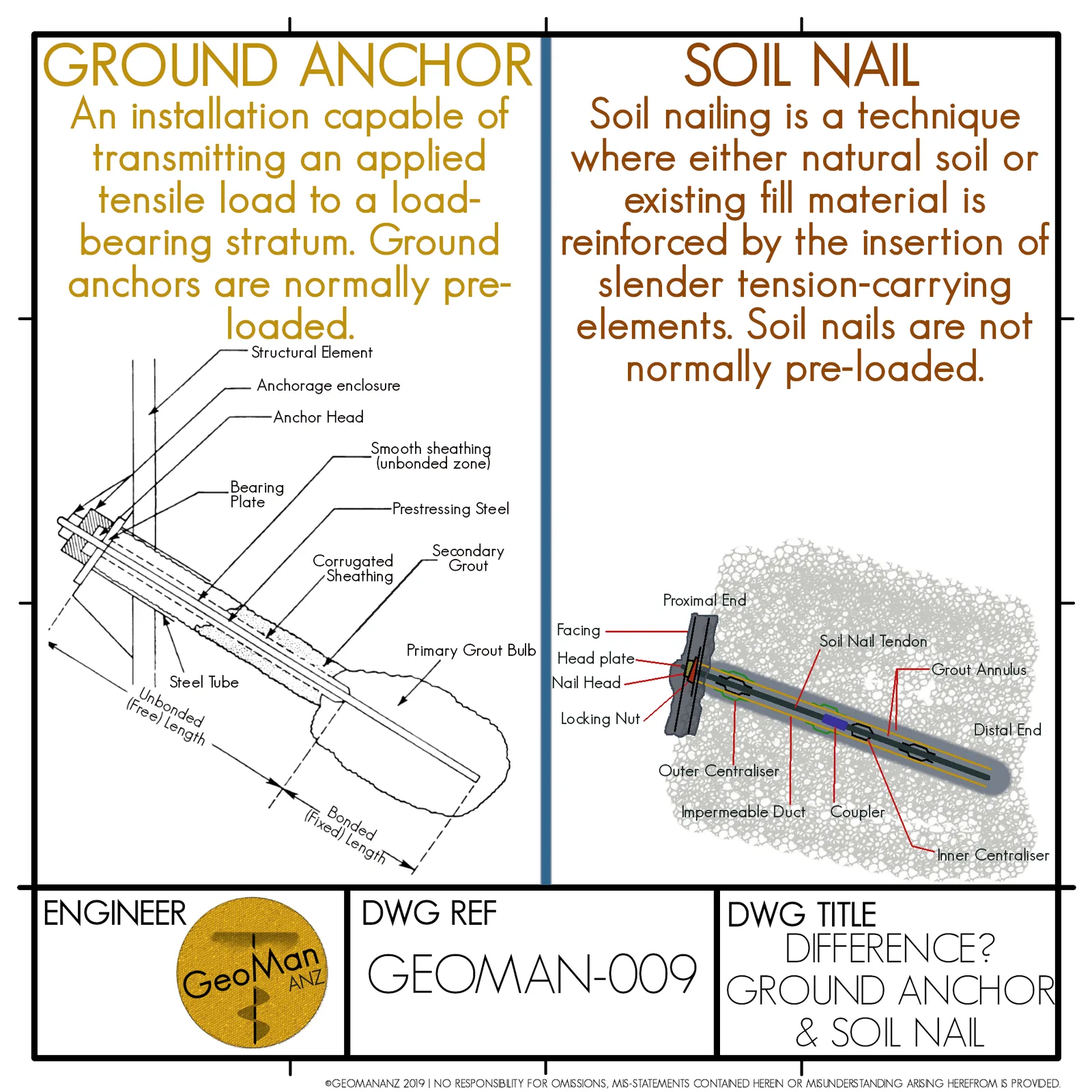
The sheet sets the two side by side. The ground anchor is normally pre-loaded and has an anchor head, a bearing plate, a free length and a fixed length ending in a grout bulb. The soil nail is not normally pre-loaded and has a facing, a head plate, centralisers, a grout annulus around the bar and a coupler joining lengths of bar.
How it works
A ground anchor is active. After the grout in the fixed length has gained strength, the tendon is tested and locked off at a set load against the bearing plate. That load clamps the wall or slope back before excavation continues. The free length lets the tendon stretch elastically without transferring load into the ground close to the wall, so the load is delivered well behind any likely failure surface. For FHWA practice the minimum unbonded length is 4.5 m for strand tendons and 3 m for bar tendons [1].
A soil nail is passive. It is a bar grouted along its full length into a drilled hole, at close spacing, with a facing tying the heads together. It carries no load until the soil starts to deform, then it picks up tension through friction along the grout. The nailed block of ground then acts like a gravity wall [2].
In practice
The difference shows in where they are used and how they are checked. Anchors suit tall walls next to sensitive structures where movement must be limited, because the prestress removes slack before digging. They need every anchor tested to above its working load. Nails suit cut slopes and temporary or permanent cuttings built top down in stages, where some movement is acceptable. Nail tests are done on a sample of sacrificial nails.
Corrosion protection is designed for both. An anchor's tendon is under constant high stress, so its protection is usually more detailed. Both need the ground beyond the wall to be stable enough to hold them: an anchor or nail fixed inside a slipping block does nothing.
REFERENCES
- [1] Federal Highway Administration (1999). Geotechnical Engineering Circular No. 4: Ground Anchors and Anchored Systems, FHWA-IF-99-015. U.S. Department of Transportation.https://www.fhwa.dot.gov/engineering/geotech/pubs/if99015.pdf. Accessed 31 Oct 2026.
- [2] Federal Highway Administration (2015). Geotechnical Engineering Circular No. 7: Soil Nail Walls Reference Manual, FHWA-NHI-14-007. U.S. Department of Transportation.https://www.fhwa.dot.gov/engineering/geotech/pubs/nhi14007.pdf. Accessed 31 Oct 2026.