
GABION BASKET RETAINING WALLS
A gabion wall is a gravity retaining wall made of wire baskets filled with rock; its own weight resists the soil behind it, and it must be checked for overturning, sliding, bearing and overall stability.
- Sheet
- GEOMAN-005
- Title
- GABION BASKET RETAINING WALLS
- First posted
- 14 Jun 2019 (first appearance in the Instagram archive)
- Parts
- 1
What the sheet shows
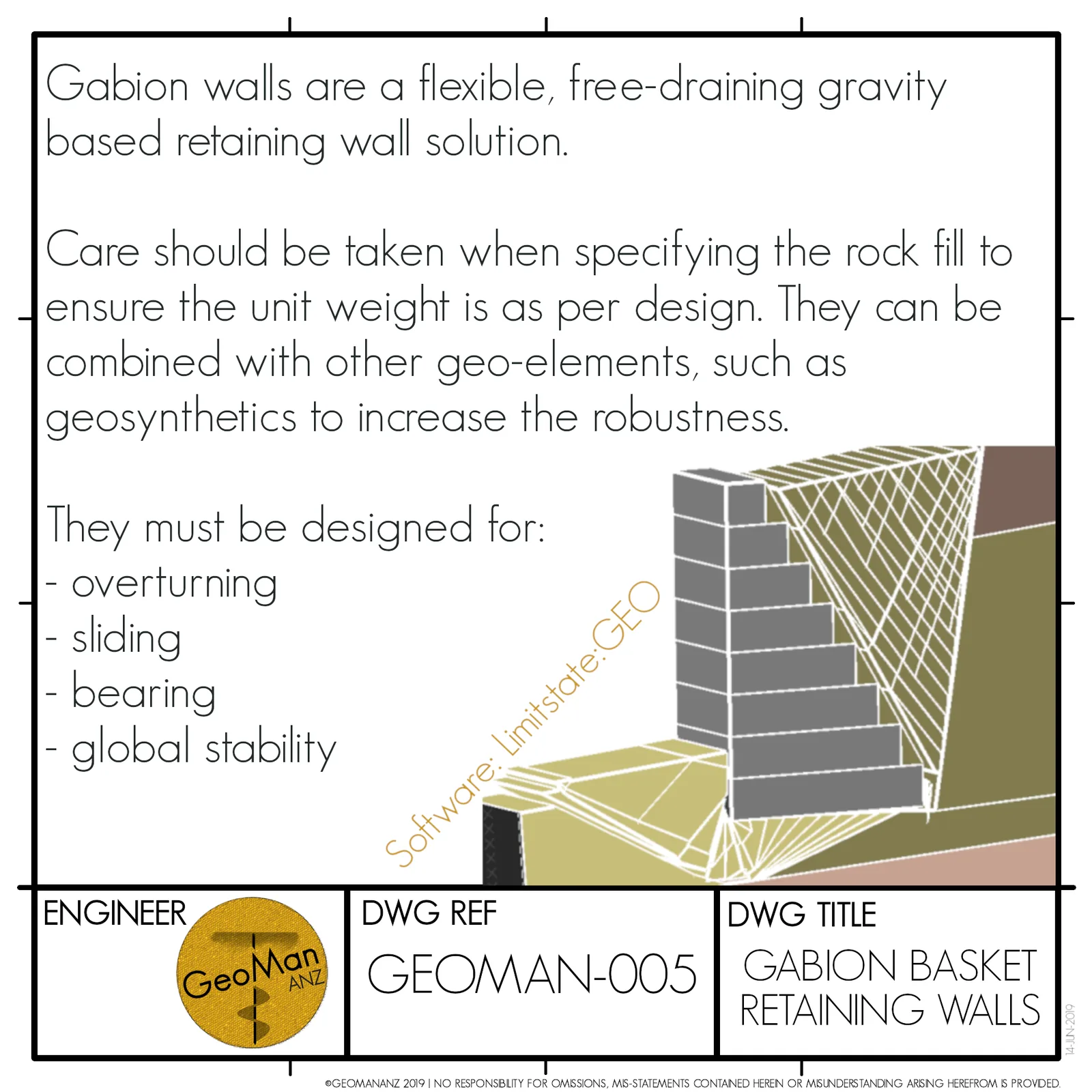
The sheet draws a stepped wall of rock-filled wire baskets holding back a slope. Its notes say a gabion wall is a flexible, free-draining gravity wall, that the unit weight of the rock fill must be specified, and that geosynthetics are used with it. It lists the design checks: overturning, sliding, bearing and global stability.
How it works
A gravity wall works by mass. The weight of the baskets, acting through the centre of the wall, resists the horizontal push of the soil behind. Gabions suit this well. The rock fill is heavy, the baskets can tolerate some settlement without cracking because they flex, and water drains straight through, so pore pressure does not build up behind the wall the way it can behind solid concrete.
The unit weight of the filled basket is lower than the unit weight of solid rock because of the voids between stones. That is why the sheet asks for it to be specified: the whole design depends on the wall weight.
A geotextile is usually placed between the retained soil and the baskets so fine soil does not wash into the rock fill.
Key equation
Pa = ½ · Ka · γ · H² (acting at H/3 above the base, dry backfill)
Worked example
For a 3 m high wall retaining soil with γ = 19 kN/m³ and Ka = 0.33, Pa = 0.5 × 0.33 × 19 × 3² = 28 kN per metre run, acting 1 m above the base. Sliding is checked by comparing the friction available under the base, the wall weight times tan δ, with this 28 kN/m. Overturning compares the moment of the wall weight about the toe with 28 × 1 = 28 kNm/m. The design factors come from the code in use [1].
In practice
Global stability is the check most often missed. A gabion wall can pass sliding and overturning and still fail with the slope it sits in, along a deep slip surface that passes under the whole wall. Check it with a slope stability analysis, especially on soft ground or on a hillside.
REFERENCES
- [1] BSI (2015). BS 8002:2015 Code of practice for earth retaining structures. BSI Knowledge.https://knowledge.bsigroup.com/products/code-of-practice-for-earth-retaining-structures-1. Accessed 31 Oct 2026.