
SECANT CONTIGUOUS SOLDIER WALLS
Secant pile walls overlap and keep water out, contiguous pile walls leave small gaps and suit dry firm ground, and soldier pile walls use widely spaced piles with infill and suit ground that stands up on its own.
- Sheet
- GEOMAN-011
- Title
- SECANT CONTIGUOUS SOLDIER WALLS
- First posted
- 1 Jul 2019 (first appearance in the Instagram archive)
- Parts
- 1
What the sheet shows
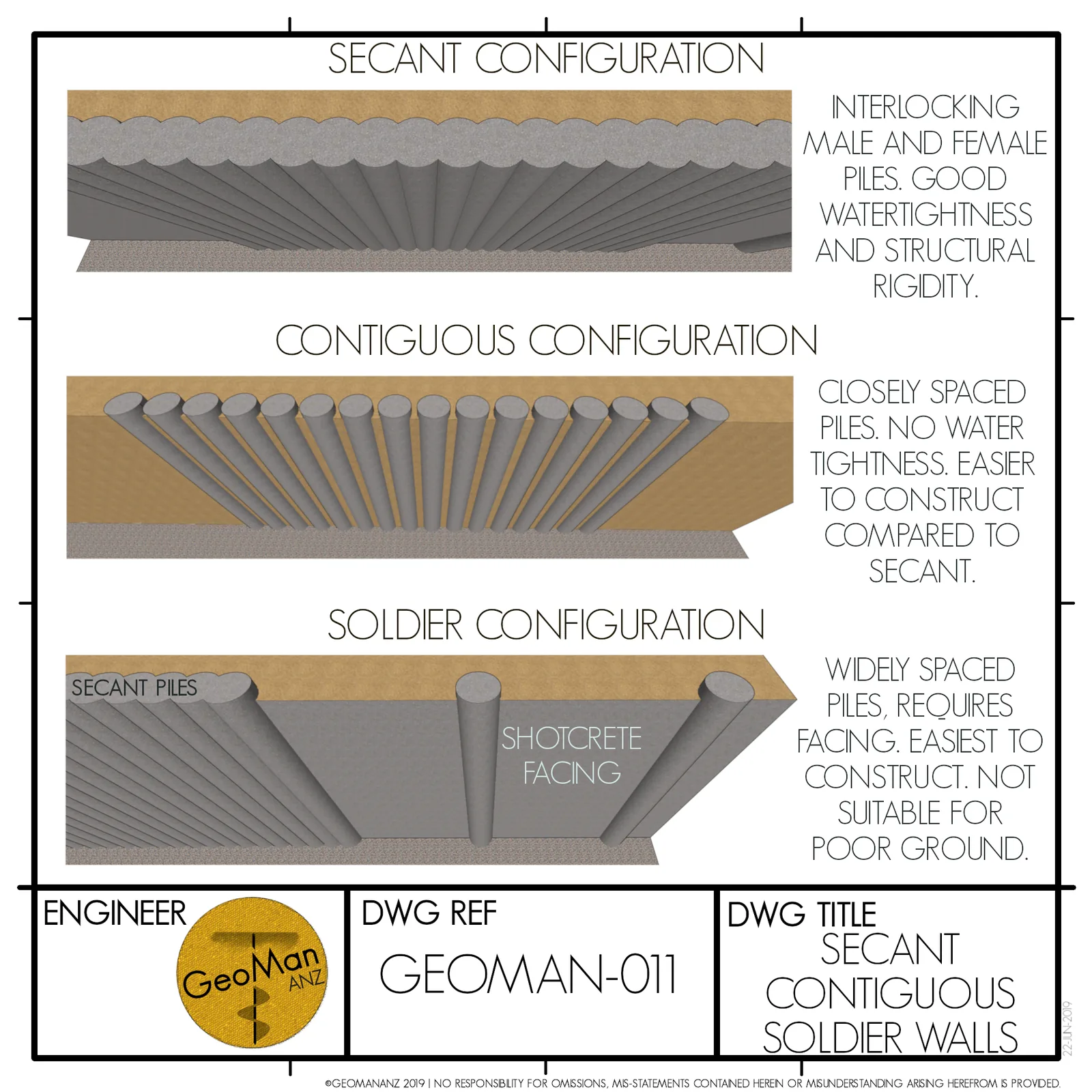
The sheet draws three embedded walls in plan. A secant wall is shown as watertight and rigid. A contiguous wall has no water tightness but is easier to build. A soldier pile wall has widely spaced piles with a shotcrete facing and is not for poor ground.
How it works
A secant wall is a row of bored piles that overlap. The first piles (often called primary or female piles) are bored and concreted, then the secondary (male) piles are bored between them, cutting into the sides of the first. The overlap closes the joints, which is what makes the wall close to watertight and, with reinforcement in the secondary piles, stiff.
A contiguous wall is a row of bored piles with small gaps between them. It is quicker and cheaper because there is no cutting into neighbouring piles. The gaps let water and fine soil through, so it suits firm ground above the water table, or ground that will be dewatered.
A soldier pile wall uses piles at wide centres, typically a few metres apart. As the excavation goes down, the face between them is closed with timber, precast panels or sprayed concrete (shotcrete). The ground has to stand unsupported for long enough to place each lift of facing, so loose sands, soft clays and ground below the water table rule it out.
In practice
Choose on water first, then stiffness, then cost. Bored piles of all three types can be installed with less vibration than driven sheet piles, which matters next to existing buildings. Where a wall must hold back groundwater or protect a neighbour from settlement, a secant wall or a diaphragm wall is the normal choice. Where the ground is firm and dry, a contiguous wall saves time. Where the excavation is temporary and the ground stands up, soldier piles are the cheapest. Design and detailing follow the retaining wall code in use [1].
REFERENCES
- [1] BSI (2015). BS 8002:2015 Code of practice for earth retaining structures. BSI Knowledge.https://knowledge.bsigroup.com/products/code-of-practice-for-earth-retaining-structures-1. Accessed 31 Oct 2026.