
GROUND ANCHOR LOAD DISTRIBUTION
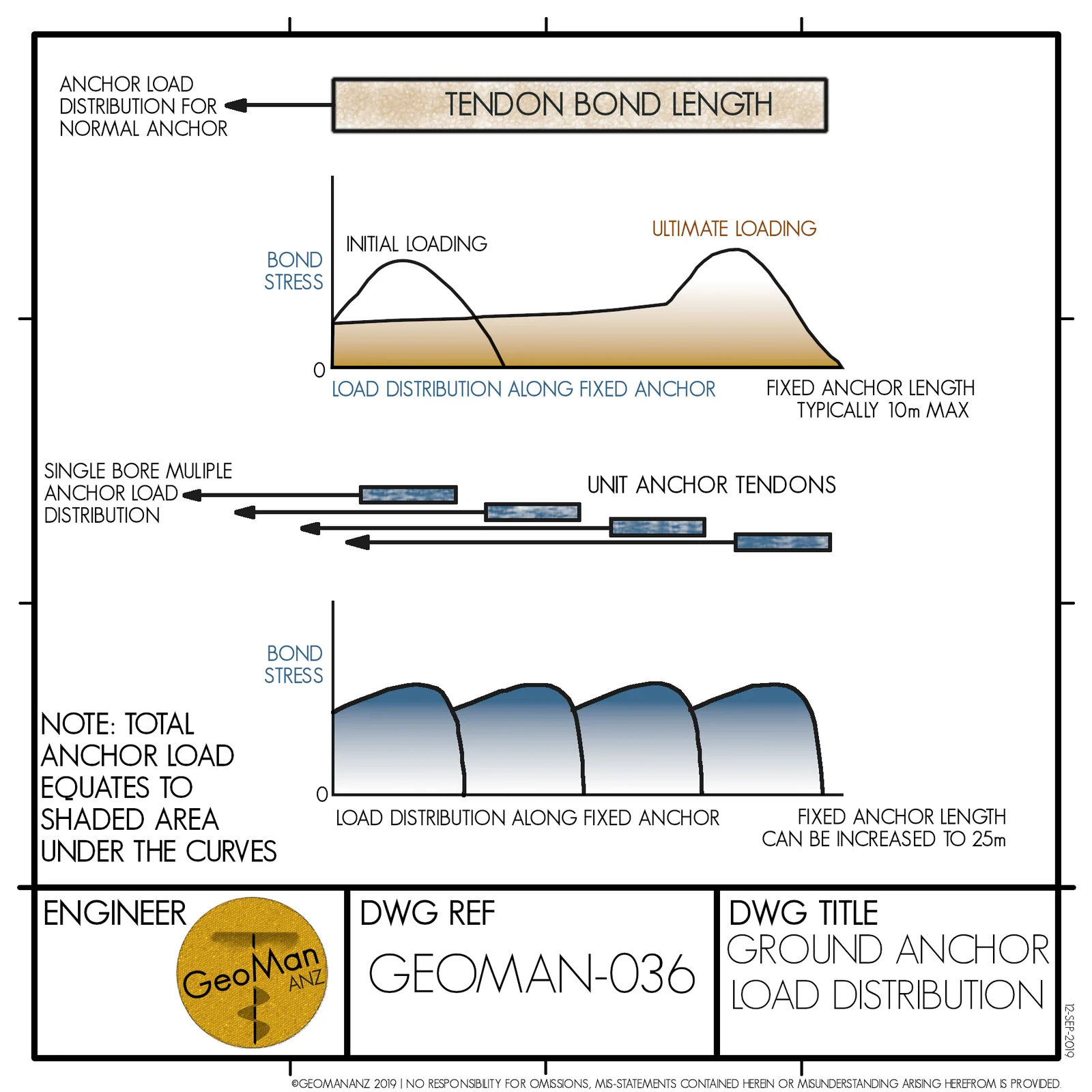
Load passes from an anchor tendon into the ground through bond stress along the fixed length, but the stress is concentrated near the top of the fixed length, so adding length beyond about 10 m gains little unless a single bore multiple anchor spreads the load.
- Sheet
- GEOMAN-036
- Title
- GROUND ANCHOR LOAD DISTRIBUTION
- First posted
- 13 Sep 2019 (first appearance in the Instagram archive)
- Parts
- 1
What the sheet shows
The sheet plots bond stress along the fixed length of a ground anchor. The curves are not flat: stress is high close to the start of the fixed length and falls away further down. The total load equals the area under the curve. The notes say a fixed length is typically 10 m at most, and that a single bore multiple anchor can extend this to 25 m.
How it works
When the tendon is stressed, the part of the fixed length nearest the wall stretches first and passes load to the grout and ground there. As that part reaches its peak bond, load moves further along. By the time the far end is working, the nearest part may have moved enough to drop to a lower, residual bond. So the stress profile travels along the anchor and peaks rather than spreading evenly.
FHWA guidance records the practical result: for typical soil anchors, bond lengths beyond 9 to 12 m do not give a significant increase in capacity, unless special procedures bond the tendon so that load reaches the longer length [1].
A single bore multiple anchor (SBMA) is one such procedure. Several shorter tendon units are placed in one hole, each with its own short fixed length at a different depth. Each unit is stressed separately, so each picks up its share along its own short length, and the combined fixed length can be much longer.
Key equation
T = π · D · L · τavg
Worked example
A 150 mm diameter fixed length of 8 m with an average ultimate bond of 100 kPa gives T = π × 0.15 × 8 × 100 = 377 kN before factors. Doubling L to 16 m does not double T, for the reason above, so the average bond over a long fixed length must be taken lower than over a short one.
In practice
Anchor capacity is proven by testing, not by calculation alone. Every production anchor is tested to above its design load before lock-off, and the test also checks that the free length is really free [1].
REFERENCES
- [1] Federal Highway Administration (1999). Geotechnical Engineering Circular No. 4: Ground Anchors and Anchored Systems, FHWA-IF-99-015. U.S. Department of Transportation.https://www.fhwa.dot.gov/engineering/geotech/pubs/if99015.pdf. Accessed 31 Oct 2026.