
LANDSLIDE CAUSES
Landslides happen when the forces driving a slope downhill exceed the strength resisting them; natural causes include heavy rain, earthquakes and erosion of the toe, and human causes include cutting, loading, and changing drainage.
- Sheet
- GEOMAN-042
- Title
- LANDSLIDE CAUSES
- First posted
- 21 Oct 2019 (first appearance in the Instagram archive)
- Parts
- 1
What the sheet shows
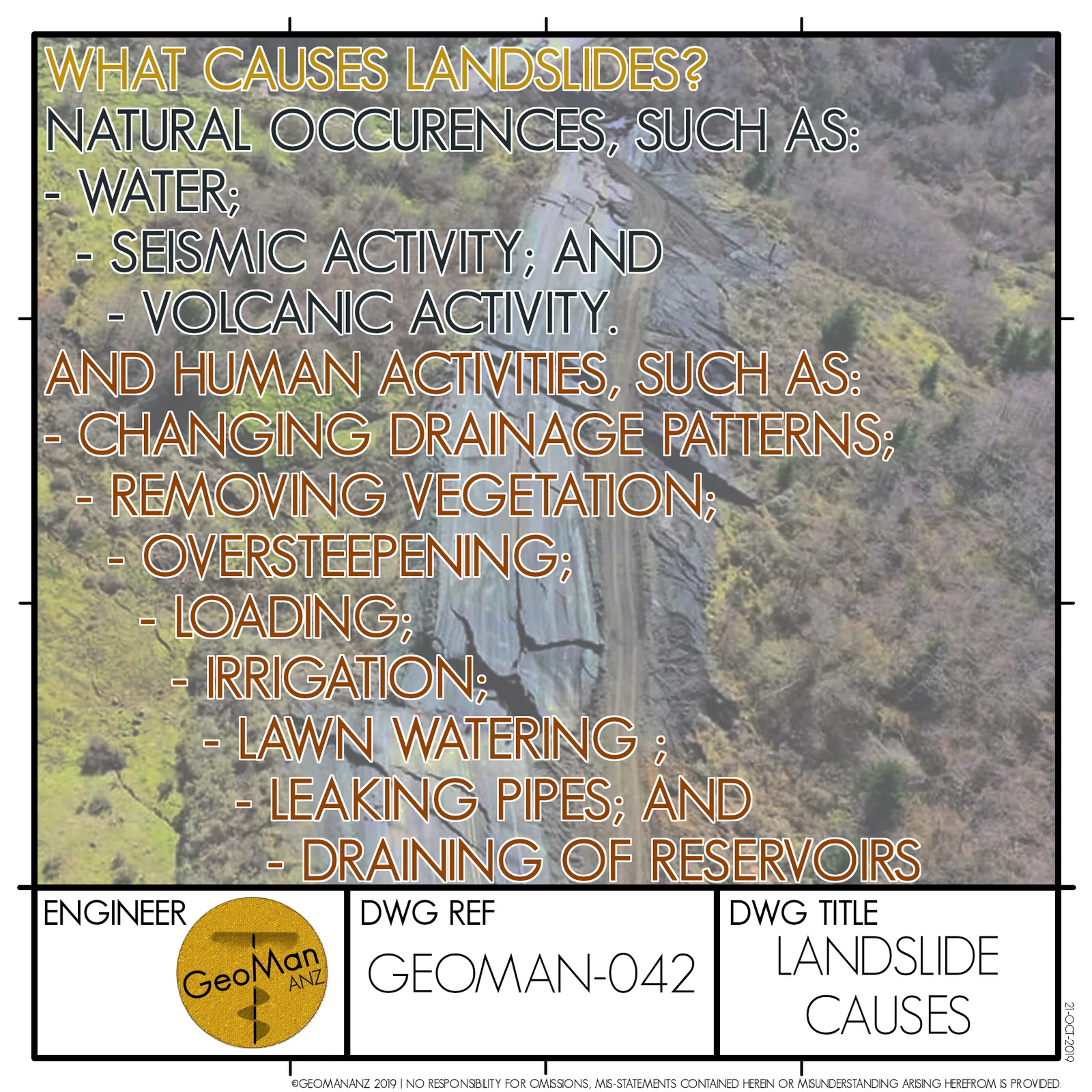
The sheet sorts the causes of landslides into two lists, natural and human, over a photograph of a slope failure.
How it works
Every slope is in balance between driving forces, mainly the weight of the ground acting downhill, and resisting forces, mainly the shear strength along a potential slip surface. A landslide starts when something tips that balance. Causes do it in one of three ways: they add load, remove support, or reduce strength.
Water is the most common trigger [1]. Heavy or prolonged rain and snowmelt raise groundwater levels, and higher pore pressure lowers effective stress and so lowers strength. Water also adds weight. Rivers and waves erode the toe of a slope and remove support. Earthquake shaking adds brief horizontal loads and can raise pore pressure in loose saturated soil. Weathering slowly weakens rock and soil over years [2].
Human causes act through the same three routes. Cutting into the toe of a slope for a road or a building platform removes support. Placing fill or buildings near the crest adds load. Leaking pipes, blocked drains, irrigation and changed surface runoff add water. Removing vegetation reduces root reinforcement and changes how much rain soaks in [2].
The sheet's two lists overlap in practice. A road cutting may stand for years, then fail in an unusually wet season: the cut removed support, and the rain supplied the trigger. A slope above a leaking water main may move with no rain at all. So the useful question after a landslide is which change made the difference, and whether it can be reversed, by draining, unloading or restoring support at the toe.
In practice
A landslide usually has several causes and one trigger. The ground may have been weakening for years before one wet week sets it moving. When assessing a slope, look for all three routes: what could add load, what could remove support, what could add water or weaken the ground. Then design drainage first, because controlling water is often the cheapest and most effective stabilisation measure.
REFERENCES
- [1] U.S. Geological Survey (2004). Landslide Types and Processes, Fact Sheet 2004-3072. U.S. Geological Survey.https://pubs.usgs.gov/fs/2004/3072/. Accessed 31 Oct 2026.
- [2] U.S. Geological Survey (2008). The Landslide Handbook: A Guide to Understanding Landslides, Circular 1325. U.S. Geological Survey.https://pubs.usgs.gov/circ/1325/. Accessed 31 Oct 2026.