SLIP CIRCLES
Slip circle analysis tests many circular slip surfaces through a slope, from a grid of trial centres, and reports the one with the lowest factor of safety; where a weak layer exists, a non-circular surface may be more critical than any circle.
- Sheet
- GEOMAN-077
- Title
- SLIP CIRCLES
- First posted
- 17 Apr 2020 (first appearance in the Instagram archive)
- Parts
- 1
What the sheet shows
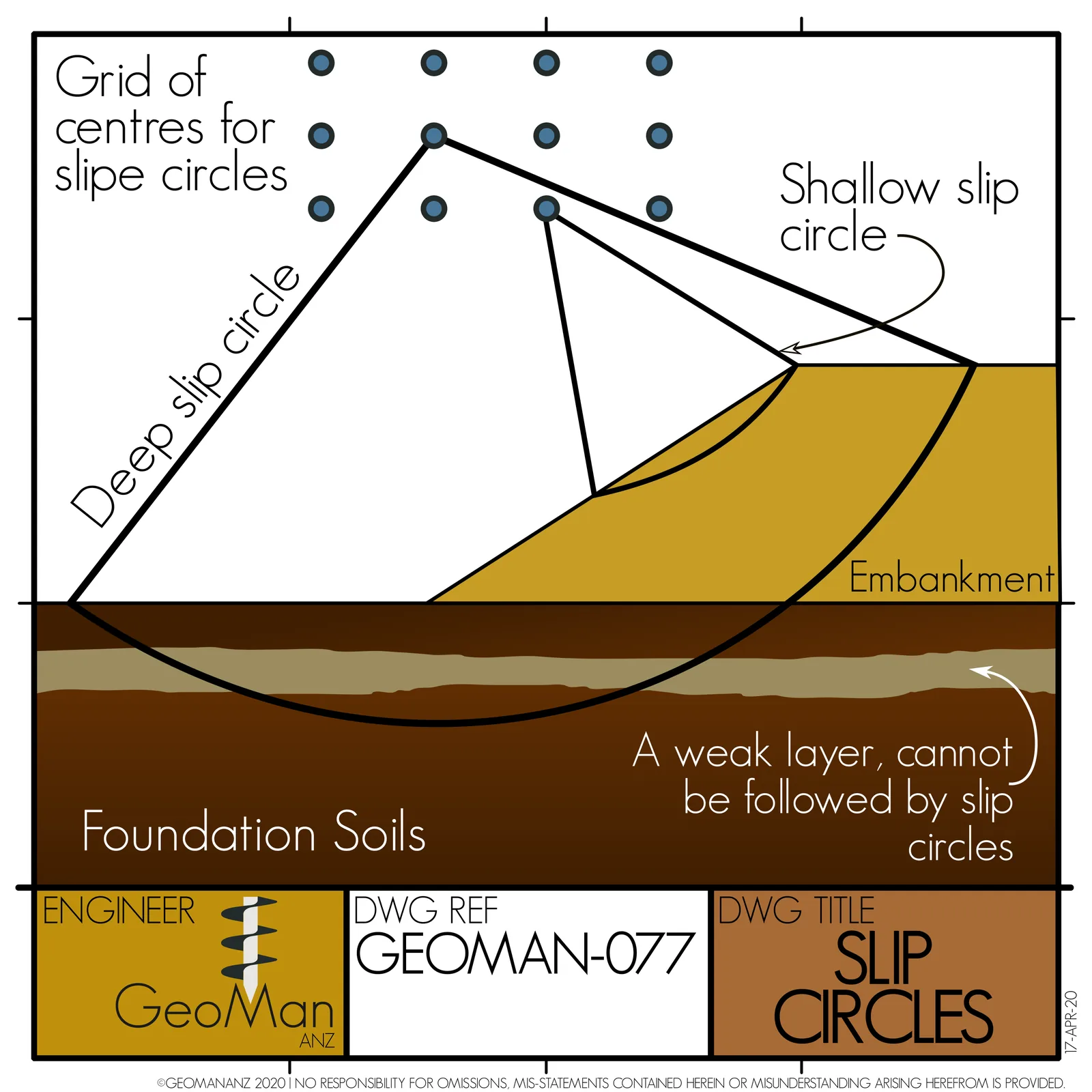
The sheet draws a slope with a grid of trial circle centres above it, a deep slip circle and a shallow slip circle, and a weak layer that a circle cannot follow.
How it works
Limit equilibrium analysis assumes a block of soil slides as a rigid body on a slip surface. For a circular surface, the driving moment is the weight of the sliding block times its lever arm about the circle centre. The resisting moment is the shear strength along the arc times the radius. The factor of safety is the ratio of resisting to driving.
Most methods split the sliding block into vertical slices to handle layered soil and water pressure, then sum forces or moments over all slices. Software repeats this for every centre on the grid and for a range of radii, then reports the lowest factor of safety. If the lowest value sits on the edge of the grid, the grid has to move or grow, because the critical circle may lie outside it.
Shallow circles check surface sloughing. Deep circles check failures that pass through the foundation soil. Both need checking.
Key equation
FoS = resisting moment / driving moment = (cu · L · R) / (W · x) (undrained, single arc)
Worked example
A trial circle in clay with cu = 30 kPa has an arc length L = 25 m and radius R = 12 m. The sliding block weighs W = 2,000 kN per metre run, with its centre of gravity x = 4 m from the circle centre. FoS = (30 × 25 × 12) / (2,000 × 4) = 9,000 / 8,000 = 1.13. Other circles on the grid may give a lower value.
In practice
Circles suit uniform ground. Where a thin weak layer, such as a clay band or a previous slip surface, runs through the slope, the critical failure follows it along a flat or wedge-shaped surface. A circle cannot bend to match it and will overestimate the factor of safety. Use a non-circular search, or define block surfaces along the weak layer [1].
REFERENCES
- [1] U.S. Geological Survey (2008). The Landslide Handbook: A Guide to Understanding Landslides, Circular 1325. U.S. Geological Survey.https://pubs.usgs.gov/circ/1325/. Accessed 31 Oct 2026.