
PITTSBURGH SINKHOLE
On 28 October 2019 a sinkhole about 6 m deep opened under a downtown Pittsburgh street and the rear of a city bus fell into it; officials did not confirm a cause at the time, and urban sinkholes like this often follow water washing soil into voids below the road.
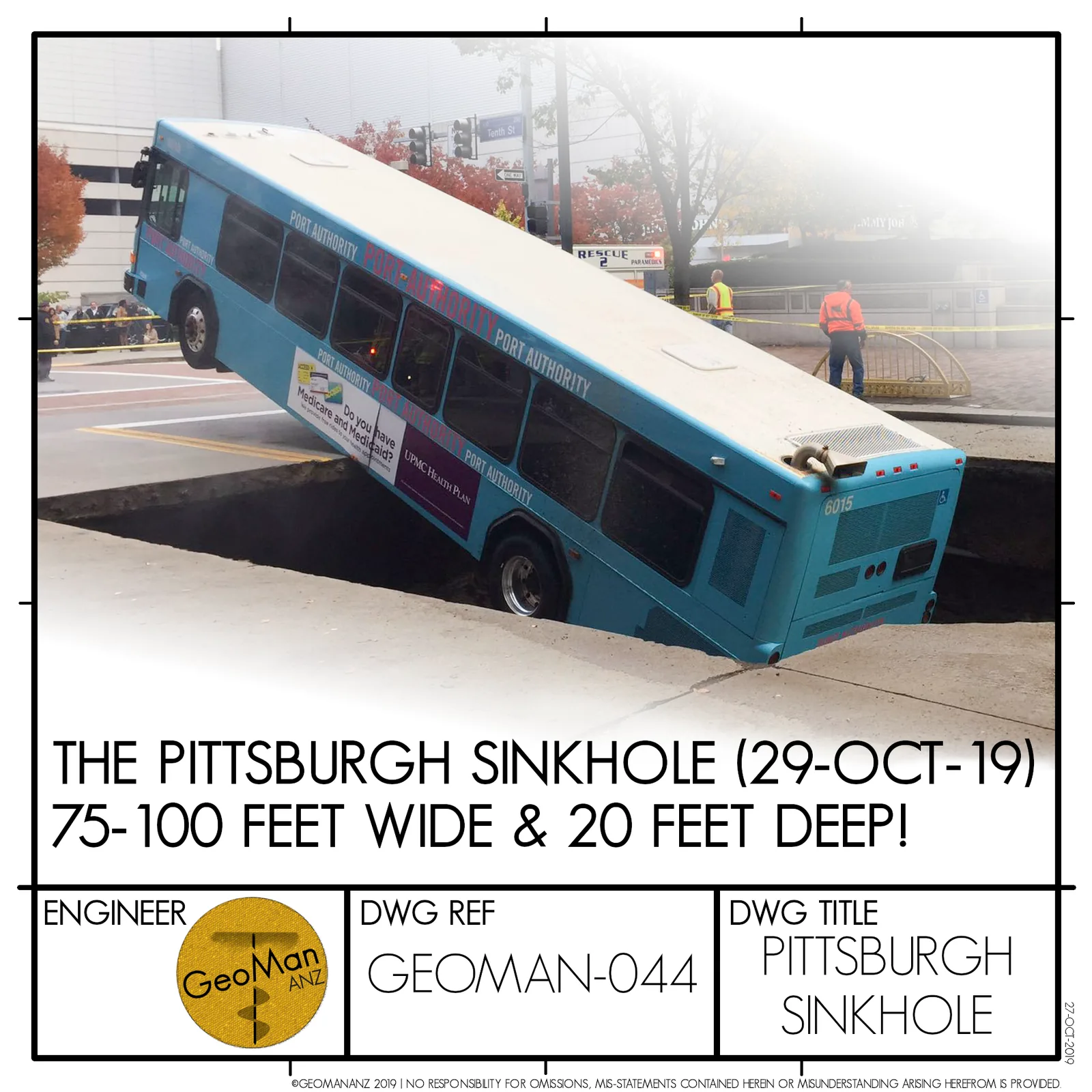
- Sheet
- GEOMAN-044
- Title
- PITTSBURGH SINKHOLE
- First posted
- 29 Oct 2019 (first appearance in the Instagram archive)
- Parts
- 1
What the sheet shows
The sheet records the Pittsburgh sinkhole with a news photograph of a bus tipped into a hole in the road. The date on the sheet is 29-OCT-19; reports date the event to the morning of 28 October 2019, local time.
What reports confirmed
The pavement collapsed around 8 am on 10th Street at Penn Avenue in downtown Pittsburgh, while a city bus was stopped at a red light, and the rear half of the bus dropped into the hole [1]. Officials said the hole was roughly 20 feet (about 6 m) deep and 75 to 100 feet (about 23 to 30 m) across [1]. The only passenger was taken to hospital and released [1]. Power, gas, water and fibre optic lines ran through the area, and water flowed into the hole for about an hour before it was shut off [1]. Officials would not confirm whether a broken water line caused the collapse [1]. The hole had an unusually rectangular shape that the transit agency could not explain at the time [1].
How it works
This section is general engineering, not a finding about this event. Natural sinkholes form where soluble rock such as limestone, gypsum or salt lies below the ground and groundwater slowly dissolves it [2]. Soil above the growing void either sags into it or collapses suddenly when the soil arch over the void can no longer span it.
In cities, many collapses are not true sinkholes in that sense. A leaking water main or a broken sewer can carry fine soil into the pipe or into a void over months or years. The road surface bridges the gap until it cannot, then it fails all at once, often under a heavy vehicle.
In practice
Signs of a developing void include repeated pothole repairs in one spot, sagging kerbs, unexplained water loss in a network and sediment in drains. Ground penetrating radar and CCTV surveys of pipes can find voids before they reach the surface.
REFERENCES
- [1] 90.5 WESA (2019). Sinkhole Opens In Downtown, Swallows Part Of Port Authority Bus During Rush Hour. 90.5 WESA, 28 Oct 2019.https://www.wesanews.org/development-transportation/2019-10-28/sinkhole-opens-in-downtown-swallows-part-of-port-authority-bus-during-rush-hour. Accessed 31 Oct 2026.
- [2] U.S. Geological Survey (n.d.). Sinkholes. USGS Water Science School.https://www.usgs.gov/special-topics/water-science-school/science/sinkholes. Accessed 31 Oct 2026.