
EFFECTIVE STRESS
Effective stress is the total stress in the ground minus the pore water pressure; it is the part of the stress carried by the soil grains, and it controls the strength and compression of soil.
- Sheet
- GEOMAN-030
- Title
- EFFECTIVE STRESS
- First posted
- 31 Aug 2019 (first appearance in the Instagram archive)
- Parts
- 1
- Topics
- Soil mechanics
What the sheet shows
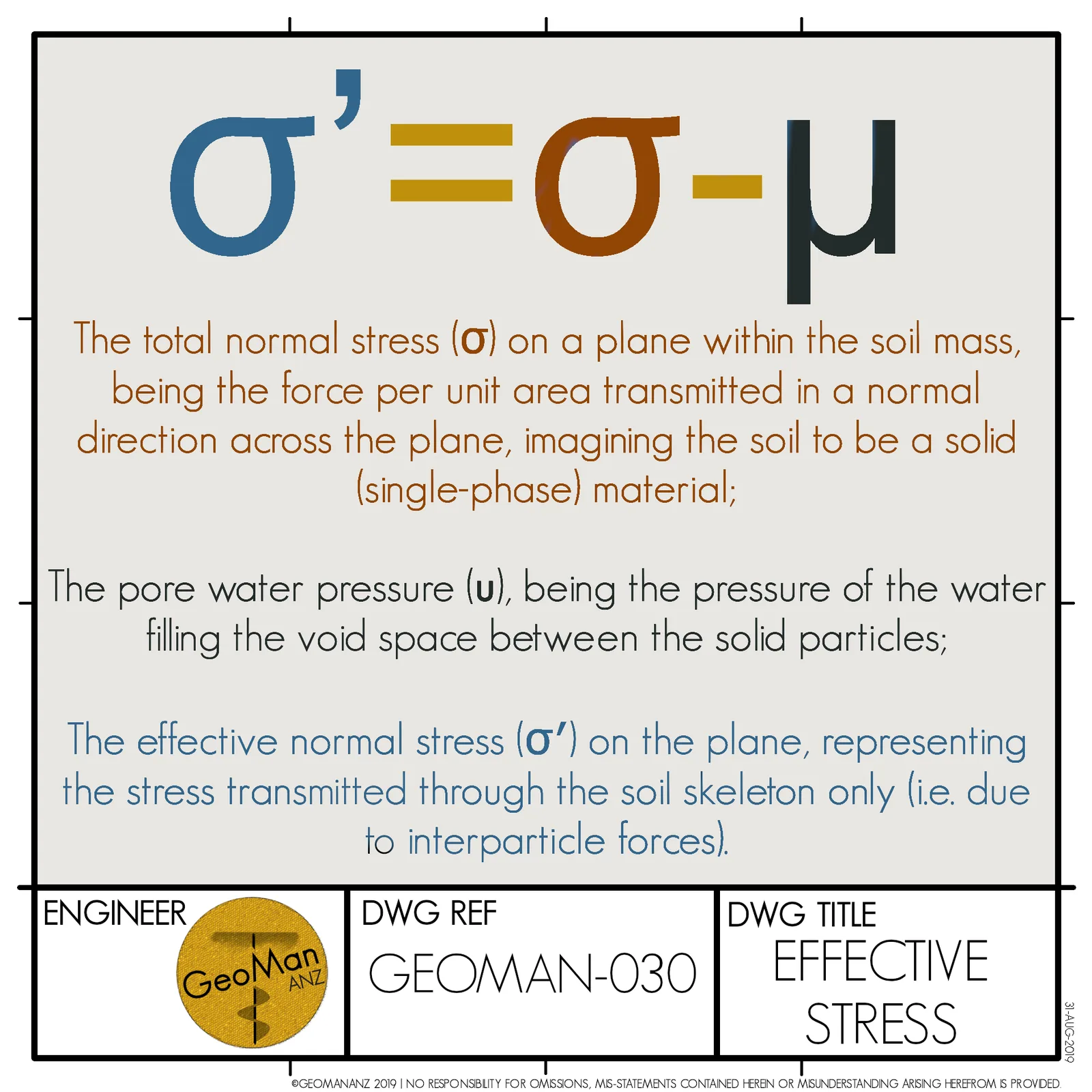
The sheet writes the principle of effective stress: effective stress equals total stress minus pore water pressure, and defines each term. (The sheet uses μ for pore pressure; most texts use u.)
How it works
Soil is a skeleton of grains with water, and sometimes air, in the spaces between. At any depth, the total vertical stress is the weight of everything above: grains, water and any surface load. Part of that weight is carried by the water, as pore pressure, and part by the grains pressing on each other at their contacts. That second part is the effective stress [1].
Only the effective stress changes how the soil behaves. Friction between grains depends on how hard they press together, so shear strength depends on effective stress. Compression happens when grains are pushed closer together, so it also depends on effective stress. A rise in pore pressure with no change in load lowers the effective stress and weakens the soil. That is how heavy rain triggers landslides and how shaking turns loose saturated sand into a liquid.
Key equation
σ' = σ - u
Worked example
Find the vertical effective stress 5 m below ground, with the water table 1 m below ground. The soil above the water table weighs 19 kN/m³ and below it 20 kN/m³. Total stress σ = 19 × 1 + 20 × 4 = 99 kPa. Pore pressure, with water standing at the water table, is u = 9.81 × 4 = 39 kPa. Effective stress σ' = 99 - 39 = 60 kPa. If the water table rose to the ground surface, u would become 49 kPa and σ' would drop to about 51 kPa, even though nothing else changed.
In practice
Almost every design calculation uses effective stress: bearing capacity, earth pressure, pile shaft friction, slope stability and settlement. So getting the groundwater level right, and how it may change, is one of the most important parts of a site investigation.
REFERENCES
- [1] ASTM International (2024). ASTM D653-24: Standard Terminology Relating to Soil, Rock, and Contained Fluids. ASTM International.https://store.astm.org/d0653-24.html. Accessed 31 Oct 2026.