
DRAINED AND UNDRAINED
Soil is drained when pore water can flow in or out as it is loaded, so effective stress controls its strength, and undrained when it cannot, so clay behaves as if it had a fixed undrained shear strength.
- Sheet
- GEOMAN-055
- Title
- DRAINED AND UNDRAINED
- First posted
- 29 Dec 2019 (first appearance in the Instagram archive)
- Parts
- 1
- Topics
- Soil mechanics
What the sheet shows
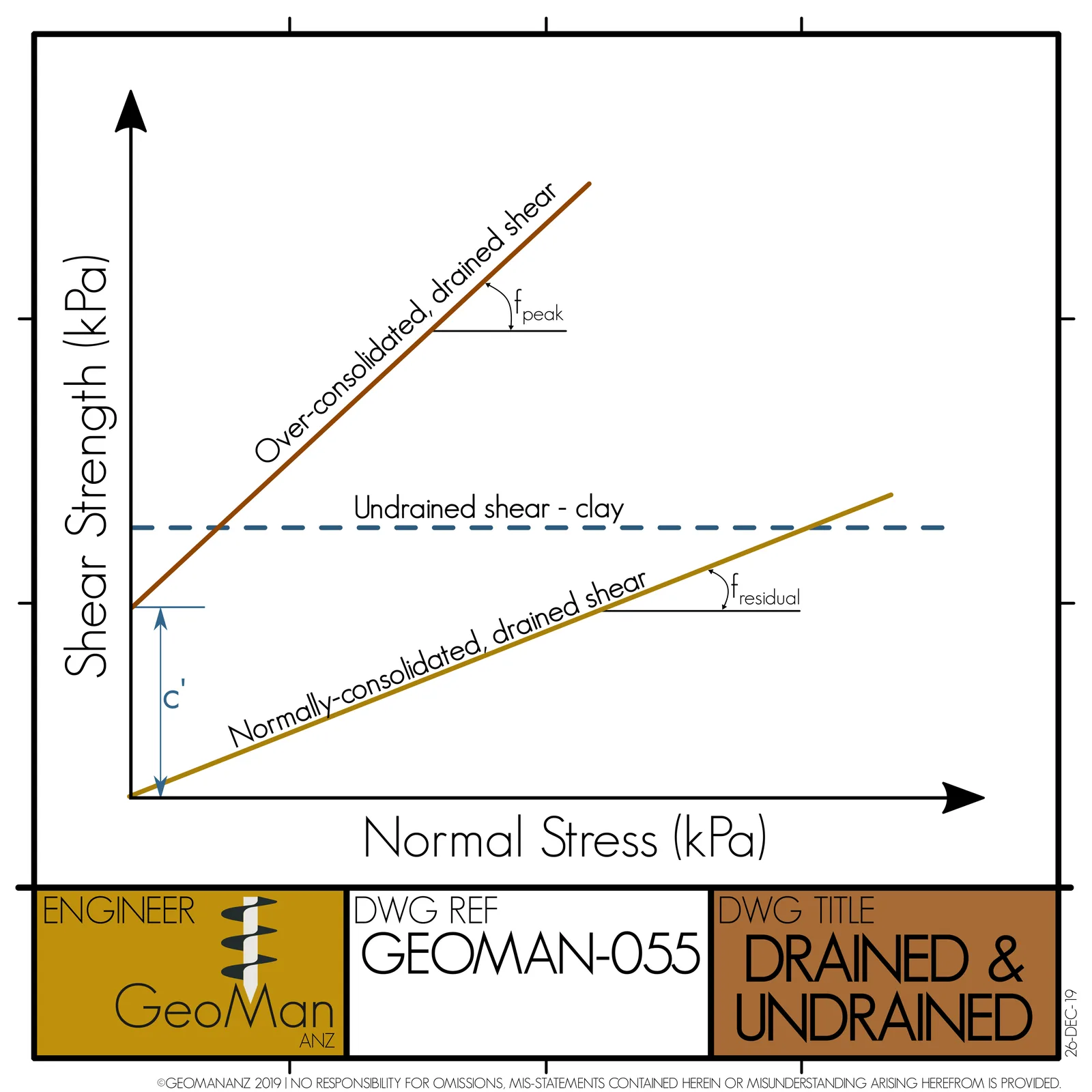
The sheet plots shear stress against normal effective stress. Two drained envelopes are drawn, one for normally consolidated (NC) clay and one for overconsolidated (OC) clay, with the peak strength parameters c' and φ' and the lower residual strength. A separate horizontal line shows undrained clay, whose strength does not change with normal stress.
How it works
Drained means the pore water has time to move as the soil is loaded, so no excess pore pressure builds up. Strength is then set by effective stress through a cohesion intercept c' and a friction angle φ'. Overconsolidated clay, which has been more heavily loaded in the past, is denser than normally consolidated clay at the same stress, so it shows a higher peak strength, often with a small c'. After large movement on a slip surface, clay particles align and the strength falls to a residual value, with a much lower friction angle.
Undrained means the water cannot escape during loading. Clay has low permeability, so under quick loading it behaves this way. Any change in total stress is matched by a change in pore pressure, the effective stress does not change, and the strength stays the same whatever the total normal stress. That is why the undrained line is flat, with strength cu and an apparent friction angle of zero.
Drained strength comes from slow tests, such as the consolidated drained triaxial test [1]. Undrained strength comes from quick tests, or from consolidated undrained tests with pore pressure measurement, which also give effective stress parameters [2].
In practice
The question is always which case governs. Short-term stability of a cut or an embankment on clay is often checked undrained. Long-term stability of a cut in clay is checked drained, because the clay swells and softens over years. Use residual strength where there has already been a landslide.
REFERENCES
- [1] ASTM International (2020). ASTM D7181-20: Standard Test Method for Consolidated Drained Triaxial Compression Test for Soils. ASTM International.https://store.astm.org/d7181-20.html. Accessed 31 Oct 2026.
- [2] ASTM International (2020). ASTM D4767-11(2020): Standard Test Method for Consolidated Undrained Triaxial Compression Test for Cohesive Soils. ASTM International.https://store.astm.org/d4767-11r20.html. Accessed 31 Oct 2026.