
COEFFICIENT OF VOLUME COMPRESSIBILITY
The coefficient of volume compressibility, mv, is the change in volume per unit volume of soil for each unit increase in effective stress, measured in an oedometer test and used to estimate consolidation settlement.
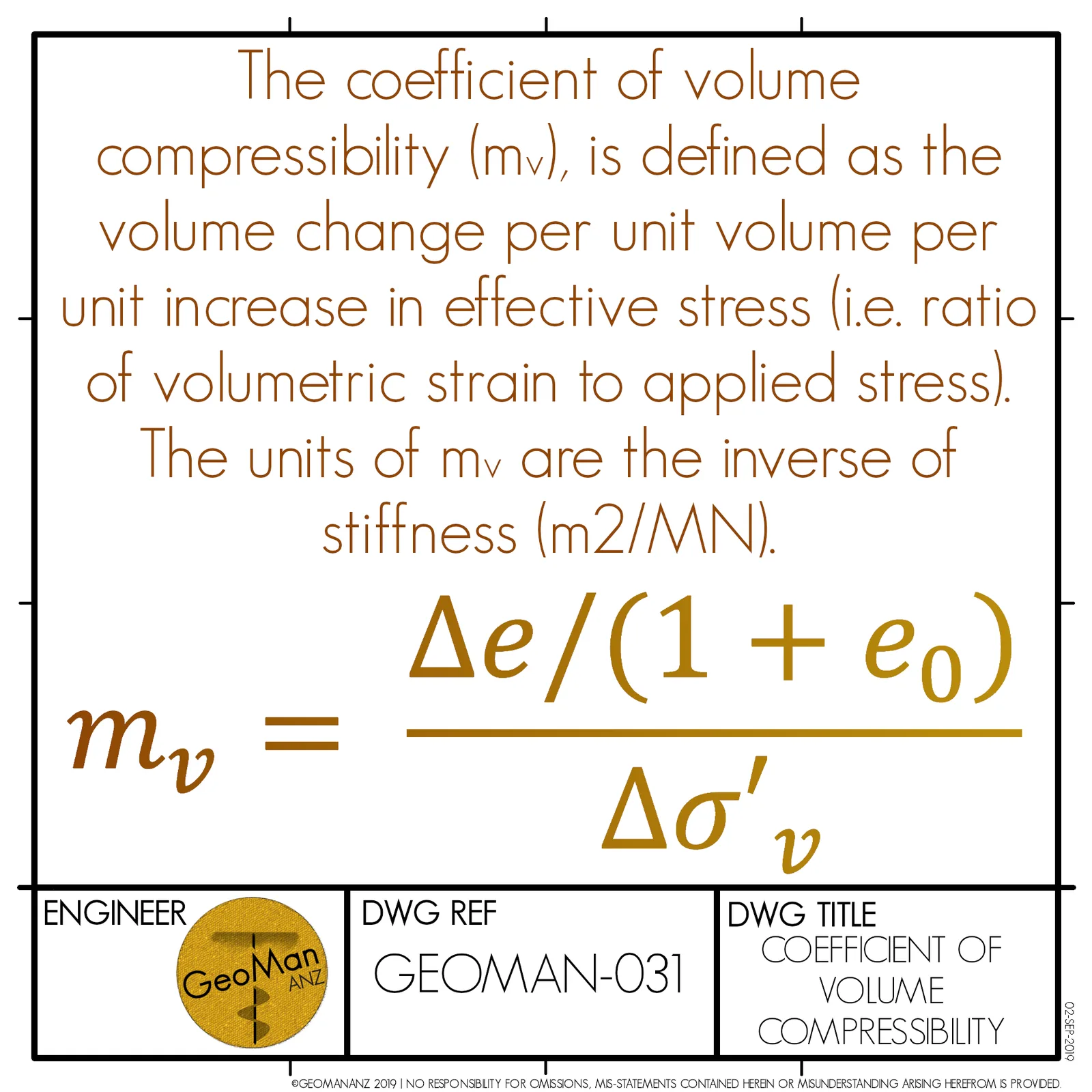
- Sheet
- GEOMAN-031
- Title
- COEFFICIENT OF VOLUME COMPRESSIBILITY
- First posted
- 2 Sep 2019 (first appearance in the Instagram archive)
- Parts
- 1
- Topics
- Soil mechanics
What the sheet shows
The sheet defines the coefficient of volume compressibility as the change in void ratio, divided by one plus the initial void ratio, per unit change in vertical effective stress. It gives the units as m²/MN.
How it works
When a load is applied to saturated clay, the water first carries it as excess pore pressure. As the water drains away, the load passes to the soil skeleton, effective stress rises, and the soil compresses. That slow compression is consolidation.
The oedometer test measures it. A disc of soil is confined in a ring, so it can only compress vertically, and loaded in steps. Each step is held until the sample stops moving, and the change in thickness or void ratio is recorded [1]. Dividing the change in void ratio by (1 + e0) gives the volumetric strain for that step; dividing again by the stress increment gives mv.
mv is not a constant. It falls as the stress rises, because soil gets stiffer as it is compressed. It is much smaller when the soil is being reloaded below its previous maximum stress than when it is loaded beyond it. So the value has to match the stress range in the ground under the new load.
Key equation
mv = (Δe / (1 + e0)) / Δσ'v, settlement s = mv · Δσ'v · H
Worked example
A clay layer 4 m thick has mv = 0.3 m²/MN over the relevant stress range. A new embankment adds 50 kPa, which is 0.05 MN/m², to the middle of the layer. Settlement s = 0.3 × 0.05 × 4 = 0.06 m, or 60 mm. For a thick layer, split it into sublayers and use the stress increase and mv at the middle of each.
In practice
mv tells you how much the clay will settle, not how fast. The rate comes from the coefficient of consolidation, cv, from the same test, and from the drainage path length. Values from the oedometer are often compared with values back-calculated from settlement monitoring on earlier embankments on the same deposit.
REFERENCES
- [1] ASTM International (2020). ASTM D2435/D2435M-11(2020): Standard Test Methods for One-Dimensional Consolidation Properties of Soils Using Incremental Loading. ASTM International.https://store.astm.org/d2435_d2435m-11r20.html. Accessed 31 Oct 2026.