
MOHR'S CIRCLE OF FAILURE
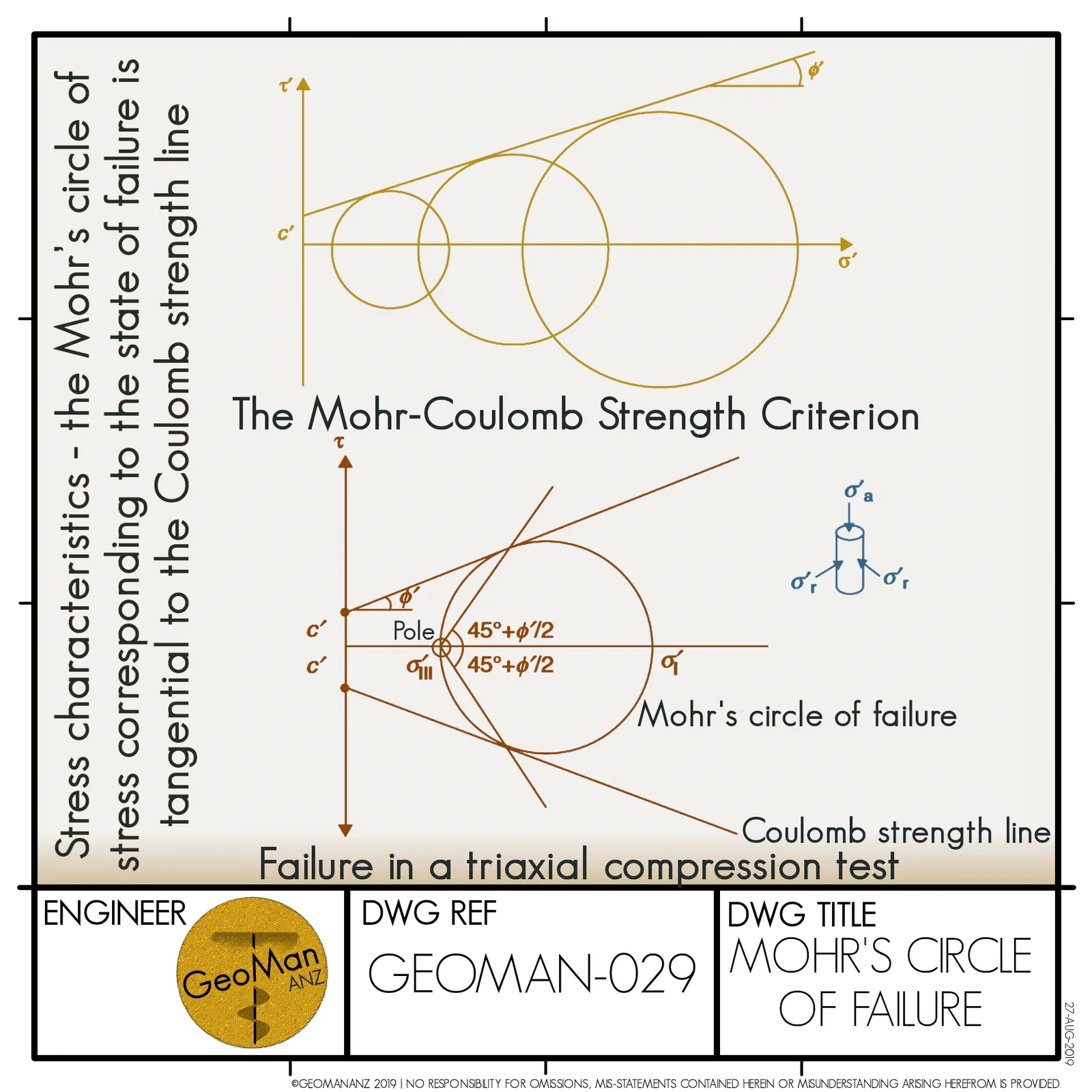
Mohr's circle shows every combination of normal and shear stress on planes through a point; a soil fails when its circle touches the Mohr-Coulomb envelope, and the failure plane is inclined at 45° plus half the friction angle to the plane of the major principal stress.
- Sheet
- GEOMAN-029
- Title
- MOHR'S CIRCLE OF FAILURE
- First posted
- 29 Aug 2019 (first appearance in the Instagram archive)
- Parts
- 1
- Topics
- Soil mechanics
What the sheet shows
The sheet draws Mohr's circles from a triaxial test, the Mohr-Coulomb failure envelope tangent to them, the pole, and the angle of the failure plane, 45° + φ'/2.
How it works
In a triaxial test, a soil cylinder is held under a cell pressure, the minor principal stress σ3, and loaded axially until it fails at the major principal stress σ1 [1]. Every plane through the sample carries a different combination of normal and shear stress. Plotted on axes of normal stress and shear stress, those combinations form a circle with its centre at (σ1 + σ3)/2 and radius (σ1 - σ3)/2.
Test several samples at different cell pressures and draw the circle for each at failure. The line that just touches all of them is the failure envelope. Its slope gives the friction angle φ' and its intercept gives c'. This is the Mohr-Coulomb criterion: failure happens when the shear stress on some plane reaches c' + σ' tan φ'.
The pole is a construction point on the circle. A line from the pole to any point on the circle is parallel to the plane that carries that stress. A line from the pole to the tangent point shows the failure plane, which lies at 45° + φ'/2 to the plane on which σ1 acts.
Key equation
σ'1 = σ'3 · tan²(45° + φ'/2) + 2c' · tan(45° + φ'/2)
Worked example
A clean sand with c' = 0 and φ' = 30° is tested at σ'3 = 100 kPa. tan(60°) = 1.73 and tan²(60°) = 3.0, so σ'1 at failure is 300 kPa. The circle has its centre at 200 kPa and a radius of 100 kPa, and the failure plane is at 60° to the horizontal plane on which σ1 acts.
In practice
Read laboratory reports with the circles in mind: check that the envelope fits the stress range in your design, not just the test points. The same relationship gives active and passive earth pressure coefficients for retaining walls.
REFERENCES
- [1] ASTM International (2020). ASTM D7181-20: Standard Test Method for Consolidated Drained Triaxial Compression Test for Soils. ASTM International.https://store.astm.org/d7181-20.html. Accessed 31 Oct 2026.