
SQUARE FOOTING
The bearing capacity of a footing is the pressure at which the soil below it fails in shear; for a footing on sand it is the sum of an overburden term and a self-weight term, each multiplied by bearing capacity, shape and depth factors.
- Sheet
- GEOMAN-059
- Title
- SQUARE FOOTING
- First posted
- 8 Jan 2020 (first appearance in the Instagram archive)
- Parts
- 1
- Topics
- Piling and foundations
What the sheet shows
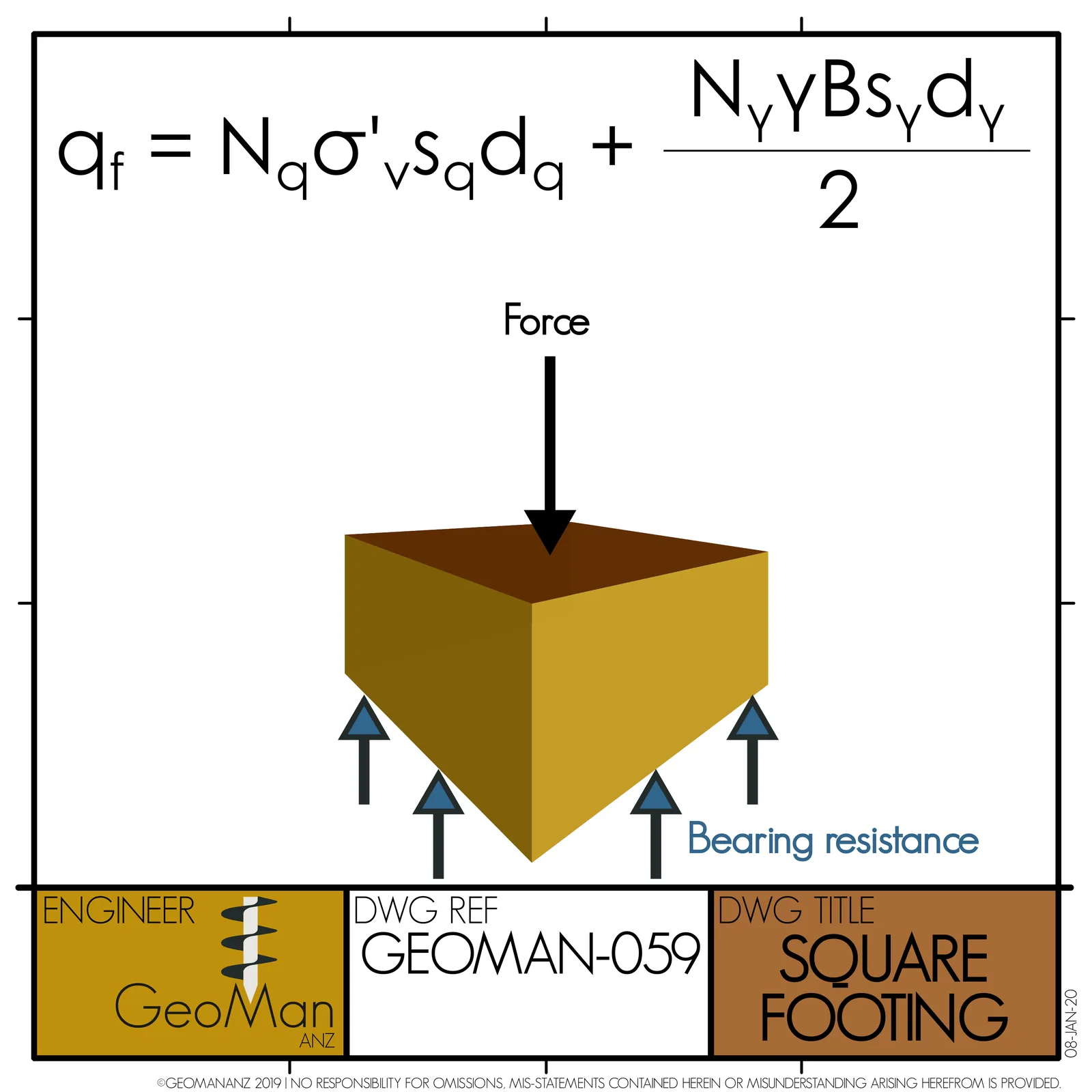
The sheet draws a square footing with the applied force and the bearing resistance below it, and writes the bearing capacity equation for drained conditions: an overburden term with Nq, sq and dq, and a self-weight term with Nγ, γ, the width B, sγ and dγ.
How it works
As load on a footing rises, a wedge of soil under it is pushed down and the soil to the sides is pushed out and up along curved shear surfaces. Bearing capacity is the pressure when that mechanism fully forms. Two things resist it in a sand. The first is the weight of soil above founding level, which holds down the soil that wants to heave: the overburden term. The second is the weight and friction of the soil inside the failure zone itself: the self-weight term, which grows with footing width.
The factors Nq and Nγ depend only on the friction angle and grow quickly with it. Shape factors raise capacity for square and circular footings compared with long strips. Depth factors account for the strength of the soil above founding level [1].
Key equation
qf = Nq · σ'v · sq · dq + ½ · Nγ · γ · B · sγ · dγ
Worked example
A 2 m square footing sits 1 m deep in dry sand with γ = 18 kN/m³ and φ' = 30°, with no water table. Using Nq = 18.4 and Nγ = 20.1, shape factors sq = 1 + sin φ' = 1.5 and sγ = 0.7, and depth factors taken as 1: overburden term = 18.4 × 18 × 1 × 1.5 = 497 kPa; self-weight term = 0.5 × 20.1 × 18 × 2 × 0.7 = 253 kPa. qf is about 750 kPa before any factor of safety or partial factor. Different codes use slightly different Nγ and shape factors, so check the set your code requires.
In practice
Capacity rarely governs alone. On most sites settlement limits the allowable pressure first, so check both. A water table at or near founding level roughly halves the soil unit weight in both terms and needs to be included.
REFERENCES
- [1] Federal Highway Administration (2002). Geotechnical Engineering Circular No. 6: Shallow Foundations, FHWA-SA-02-054. U.S. Department of Transportation.https://www.fhwa.dot.gov/engineering/geotech/pubs/010943.pdf. Accessed 31 Oct 2026.