
FOUNDATION TYPES
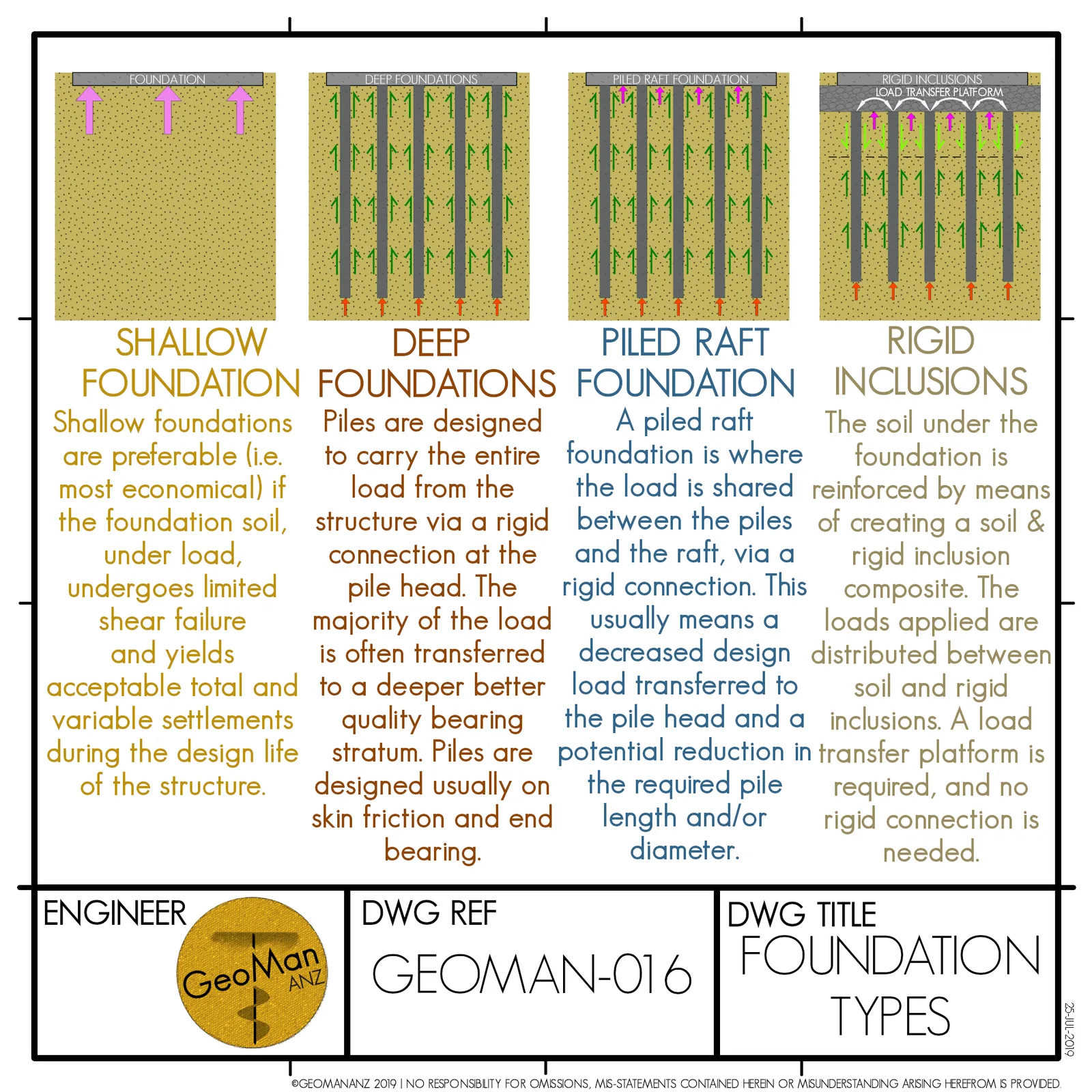
Foundations are shallow when they spread load at the surface, deep when piles carry it down to stronger ground, and in between are piled rafts, which share load between raft and piles, and rigid inclusions, which reinforce the ground below a granular load transfer platform.
- Sheet
- GEOMAN-016
- Title
- FOUNDATION TYPES
- First posted
- 25 Jul 2019 (first appearance in the Instagram archive)
- Parts
- 1
- Topics
- Piling and foundations
What the sheet shows
The sheet draws four foundation families side by side: a shallow foundation, a deep (piled) foundation, a piled raft, and rigid inclusions with a load transfer platform between the inclusions and the structure.
How it works
A shallow foundation, a pad, strip or raft, spreads load over enough area near the surface that the soil can carry it without failing and without settling too much [1]. It is the cheapest choice where good ground is close to the surface.
A deep foundation takes load down through weak or compressible ground. Piles carry it by friction along their sides and by end bearing at the toe [2]. The structure is connected to the piles through a pile cap, and the piles are designed to carry the full load.
A piled raft combines the two. The raft carries part of the load in bearing, and the piles are added mainly to reduce settlement. Because the raft is doing work, fewer or shorter piles are needed than for a fully piled design.
Rigid inclusions are stiff columns, often concrete or grout, installed in soft ground but not connected to the structure. A layer of compacted granular fill, the load transfer platform, sits between the inclusions and the slab or footing. Arching in the platform sends most of the load onto the inclusions, and the soft soil between them carries the rest. The system is treated as ground improvement rather than as piling.
In practice
The choice comes from the ground profile, the load and how much settlement the structure can take. Light buildings on firm ground get footings. Heavy structures over soft clay get piles. Large rafts that would settle a little too much are candidates for a piled raft. Where the ground varies across a site, a mix of types may be needed, and the joints between them must allow for different settlements. Embankments, tanks and warehouse slabs on soft ground are typical uses of rigid inclusions.
REFERENCES
- [1] Federal Highway Administration (2002). Geotechnical Engineering Circular No. 6: Shallow Foundations, FHWA-SA-02-054. U.S. Department of Transportation.https://www.fhwa.dot.gov/engineering/geotech/pubs/010943.pdf. Accessed 31 Oct 2026.
- [2] Federal Highway Administration (2016). Design and Construction of Driven Pile Foundations, Volume I (Geotechnical Engineering Circular No. 12), FHWA-NHI-16-009. U.S. Department of Transportation.https://www.fhwa.dot.gov/engineering/geotech/pubs/gec12/nhi16009_v1.pdf. Accessed 31 Oct 2026.